Carbon Conscious Consulting (CCC)
+27 67 833 8132
Keywords: ESG consulting, SMEs in South Africa, sustainable business practices, ESG strategy, business growth, ethical governance, social impact, environmental sustainability, SME development, responsible business, sustainability consulting, green business strategy, governance framework, ESG implementation, South African SMEs growth.
In today’s fast-paced and increasingly conscientious business environment, small and medium-sized enterprises (SMEs) in South Africa are facing unique challenges. These businesses, which make up the backbone of the South African economy, are often pressured by tight margins, fierce competition, and rapidly changing regulations. On top of that, the global shift toward sustainability and ethical governance is placing additional demands on these enterprises. Environmental, Social, and Governance (ESG) consulting is emerging as a critical strategy for SMEs aiming to not only survive but thrive in this environment. This blog post will explore why integrating ESG principles is essential for the long-term success of SMEs and how it can be a catalyst for growth, innovation, and resilience.
Before delving into the benefits of ESG consulting, it’s crucial to recognize the specific challenges faced by SMEs in South Africa [1]. These challenges often include:
– Limited Access to Capital: SMEs often need help to secure financing due to perceived risks by lenders.
– Regulatory Burdens: Navigating the complex landscape of South African regulations can be overwhelming for small businesses.
– Market Competition: Competing against larger, more established companies with more significant resources is a constant uphill battle.
– Operational Inefficiencies: Many SMEs need more resources or expertise to optimize their operations, leading to wasted time and money.
– Brand Visibility and Trust: Establishing a brand presence and gaining customer trust is incredibly challenging in a market where consumers are increasingly demanding ethical and sustainable practices.
ESG isn’t just for big corporations. SMEs, too, can benefit immensely from implementing ESG practices [2]. Here’s why ESG is vital:

For SMEs, implementing ESG principles early in their business lifecycle is crucial. Implementing an ESG framework early in the business ensures that these principles are deeply embedded into the company’s DNA, influencing every decision from the ground up [3]. Here’s why early implementation is so important:
– Cultural Integration: Early adoption of ESG principles fosters a company culture that values sustainability, ethics, and transparency. This culture becomes a cornerstone of the business, guiding future growth.
– Long-Term Cost Savings: By addressing environmental and social impacts early, SMEs can avoid future costs associated with regulatory compliance, resource inefficiencies, and reputational damage.
– Building Trust with Stakeholders: Early commitment to ESG builds trust with investors, customers, employees, and communities. This trust is invaluable and can set the stage for long-term success.
– Easier Scaling: As the business grows, having ESG principles already in place makes it easier to scale operations sustainably. It’s much more complex and more costly to retrofit these principles into a mature organization.
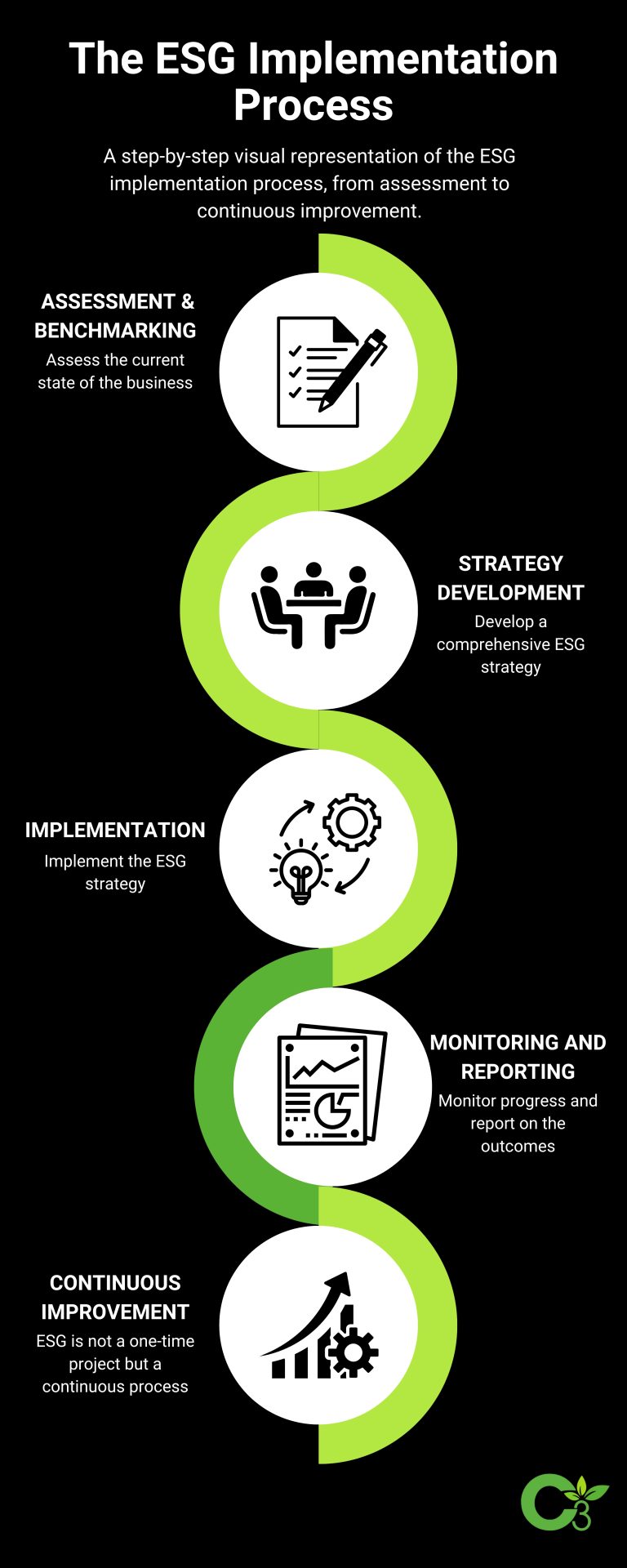
Implementing an ESG framework might seem daunting, especially for SMEs with limited resources. However, working with an ESG consultant can simplify the process and ensure that the framework is tailored to the specific needs of the business (Figure 2). Here’s how an ESG consultant typically helps SMEs:
The first step in the process is to assess the current state of the business. This involves evaluating the company’s environmental impact, social practices, and governance structures. The consultant will benchmark the SME against industry standards and best practices, identifying areas for improvement.
Based on the assessment, the consultant will work with the SME to develop a comprehensive ESG strategy. This strategy will include short-term and long-term goals, specific actions to achieve these goals, and key performance indicators (KPIs) to track progress.
The next step is to implement the ESG strategy. This may involve changes to business operations, supply chain management, employee training, and customer engagement. The consultant will guide the SME through this process, ensuring that the changes are practical and sustainable.
Once the ESG framework is in place, it’s essential to monitor progress and report on the outcomes. The consultant will help set up monitoring systems to track KPIs and ensure that the business is on track to meet its ESG goals. Regular reporting is also crucial for maintaining transparency with stakeholders.
ESG is not a one-time project but a continuous process. The consultant will work with the SME to regularly review and update the ESG strategy, ensuring that it evolves with the business and remains relevant in a changing environment.
Implementing ESG practices isn’t just about business growth; it’s about contributing to a more significant global effort to address pressing environmental and social issues [4]. Here’s why ESG is valuable to the environment:
– Reducing Carbon Footprint: By adopting energy-efficient practices and investing in renewable energy, businesses can significantly reduce their carbon footprint, contributing to the fight against climate change.
– Sustainable Resource Management: ESG practices encourage businesses to use resources more efficiently, reducing waste and minimizing environmental impact. This includes everything from water conservation to sustainable sourcing of materials.
– Protecting Biodiversity: Businesses that prioritize ESG are more likely to support initiatives that protect Biodiversity, whether through sustainable land use practices or supporting conservation efforts.
– Social Equity: ESG also encompasses social responsibility, ensuring that businesses contribute to social equity by treating employees fairly, supporting local communities, and upholding human rights.
Consider the example of an SME in the agricultural sector that decided to integrate ESG principles early in its development. By working with an ESG consultant, the company was able to implement sustainable farming practices, reduce water usage, and improve labour conditions. Not only did this lead to cost savings, but the company also gained a competitive advantage in the market by appealing to eco-conscious consumers. Additionally, the business attracted investment from a socially responsible fund, enabling it to expand operations and further its impact. This success story illustrates how ESG consulting can transform challenges into opportunities, driving growth while making a positive contribution to society and the environment.
For SMEs in South Africa, the integration of ESG principles is not just a trend—it’s a necessity for sustainable growth and long-term success. ESG consulting offers a clear path for these businesses to overcome their unique challenges, seize new opportunities, and build a resilient future.
By implementing ESG practices early, SMEs can embed sustainability, ethics, and governance into their core operations, positioning themselves as leaders in their industry. The process of working with an ESG consultant ensures that these principles are applied effectively and efficiently, leading to tangible benefits for the business, its stakeholders, and the environment.
In a world where consumers, investors, and regulators are increasingly prioritizing sustainability, SMEs that embrace ESG will be well-positioned to thrive. It’s time for South African SMEs to recognize the value of ESG consulting and take the necessary steps to integrate these principles into their business strategies—because the future of business is sustainable, and the future starts now.
[1] A. K. Ekene and T. D. Kelly, “Opportunities, Challenges and Risks: The South African Business Environment Profiling Opportunities and Challenges of Running Small and Medium-Sized Businesses in the Post-Apartheid Vhembe District of the Limpopo Province of South Africa,” Sustainable and Responsible Business in Africa: Studies in Ethical Leadership, pp. 41–61, Dec. 2024, doi: 10.1007/978-3-031-35972-9_3.
[2] J. Zhu and F. Huang, “Transformational Leadership, Organizational Innovation, and ESG Performance: Evidence from SMEs in China,” Sustainability 2023, Vol. 15, Page 5756, vol. 15, no. 7, p. 5756, Mar. 2023, doi: 10.3390/SU15075756.
[3] E. M. Lange and N. G. Banadaki, “ESG consideration in venture capital: drivers, strategies and barriers,” Studies in Economics and Finance, vol. 41, no. 3, pp. 724–739, Jun. 2024, doi: 10.1108/SEF-06-2023-0380/FULL/XML.
[4] D. Daugaard and A. Ding, “Global Drivers for ESG Performance: The Body of Knowledge,” Sustainability 2022, Vol. 14, Page 2322, vol. 14, no. 4, p. 2322, Feb. 2022, doi: 10.3390/SU14042322.
Dr. Leeth Singh is a multifaceted leader in the fields of environmental science, sustainability, and project management, with a rich background in Geographic Information Systems (GIS) and remote sensing. Grounded in a PhD in environmental science, Leeth’s career trajectory has been marked by a relentless pursuit of knowledge and a steadfast commitment to effecting positive change on a global scale.